Reducing material waste: 10 practical tips for small construction companies
Material loss often feels like “small bits”: a box of screws that goes missing, a few packs of plaster that get wet, a bundle of battens delivered just a little too early. Add that up over a month, and you see it reflected in your margin, in extra trips, and in subsequent discussions about exactly what was consumed.
This hits small construction companies and self-employed professionals harder than large players. You have less financial buffer, you work on multiple jobs simultaneously, and administration often has to be done after working hours. It is therefore not surprising that materials disappear or are left lying unused. Some sources even state that a substantial portion of the delivered materials is ultimately thrown away; Fieldwire refers to an estimate of around 30% of the total weight of materials delivered to the construction site.
In this article
Why material loss so often happens “secretly”
Material loss is rarely one big mistake. Usually, it is a chain of small decisions: “just order extra, so we don’t run short”, “just put it over there”, “I’ll write it down later”. And that is exactly where the gaps are.
A second reason is timing. If material is already there before you need it, you have to store, protect, move, count, and guard it. Every extra action increases the risk of damage, theft, or loss.
And then there is the administrative side. With loose notes, text messages, spreadsheets, and receipts in the mailbox, the overview is lost. You cannot manage consumption if you only see weeks later what has actually been used.
Where does it go wrong? Causes you see almost everywhere
Most material losses fall into a few categories. If you recognize these in your own work, you know immediately where the gains lie.
| Cause | What you often see in the workplace | What helps in practice |
|---|---|---|
| Overorder | “Just to be safe” extra packs, rolls, or meters | Calculate more tightly, order in phases, choose standard sizes |
| Damage due to storage/weather | Wet boards, warped wood, hardened bags | Store dry and off the ground, cover, in the right place on the construction site |
| Theft/disappearance | Small parts, batteries, clearance items | Lockable storage, key management, count at start/end |
| Incorrect delivery | Too late, too early, damaged, wrong type | Check delivery immediately, photo and notification the same day |
| Poor registration | Double ordered, consumption not booked | One central registration per job, at a fixed time of day |
One sentence that is often true: if you don't record it, you can't find it again.
10 practical tips to reduce material waste (without the hassle)
Choose two to do this week already. The effect usually comes faster than you think.
Order in phases, not all at once
Split your order by work phase. Less storage on the construction site means less damage and a lower risk of “disappearing”.Calculate more precisely and work with fixed units
Use standard lengths and packaging in your calculations so that you do not consistently purchase “just a little too much”.Schedule delivery for the moment you are actually going to process it.
Just-in-time is not a big word, it is simply: deliver today, process today.Create one designated storage area on the construction site
Better a small, clear storage zone than material in five places. Keep it off the ground and keep walkways clear.Check deliveries immediately, including any damage.
Not after two days. If necessary, take a photo immediately and document what is missing or broken.Label leftover material per job
A simple “Project X, date, contents” sticker prevents leftover stock from becoming anonymous and later disappearing into the noise.Record cutting waste, even if it feels small.
Do you notice that you consistently have a lot of waste with a single material? Then something is wrong with the dimensions, working method, or order.Limit “open bins” with small items
Screws, plugs, and sealant disappear the fastest. Work with lockable crates and replenish per job, not from a large mixed stock.Agree on: who books material and when
Make it part of the wrap-up. Setting aside five minutes saves searching, calling, and discussions later.Zet additional work directly on the invoice, including photo
Unrecorded extra material is a double loss: you purchase it and it is missing from the invoice.
Reducing loss starts with better record-keeping (not with working harder)
Many teams try to solve material loss by “paying closer attention.” That helps for a week, until things get busy. A fixed, simple working method works longer.
That is why central registration is such a turning point. If everyone records in the same place what has been used, when, and on which job, you suddenly *can* take control. You spot discrepancies faster, you order fewer duplicates, and you have less “mystery usage”.
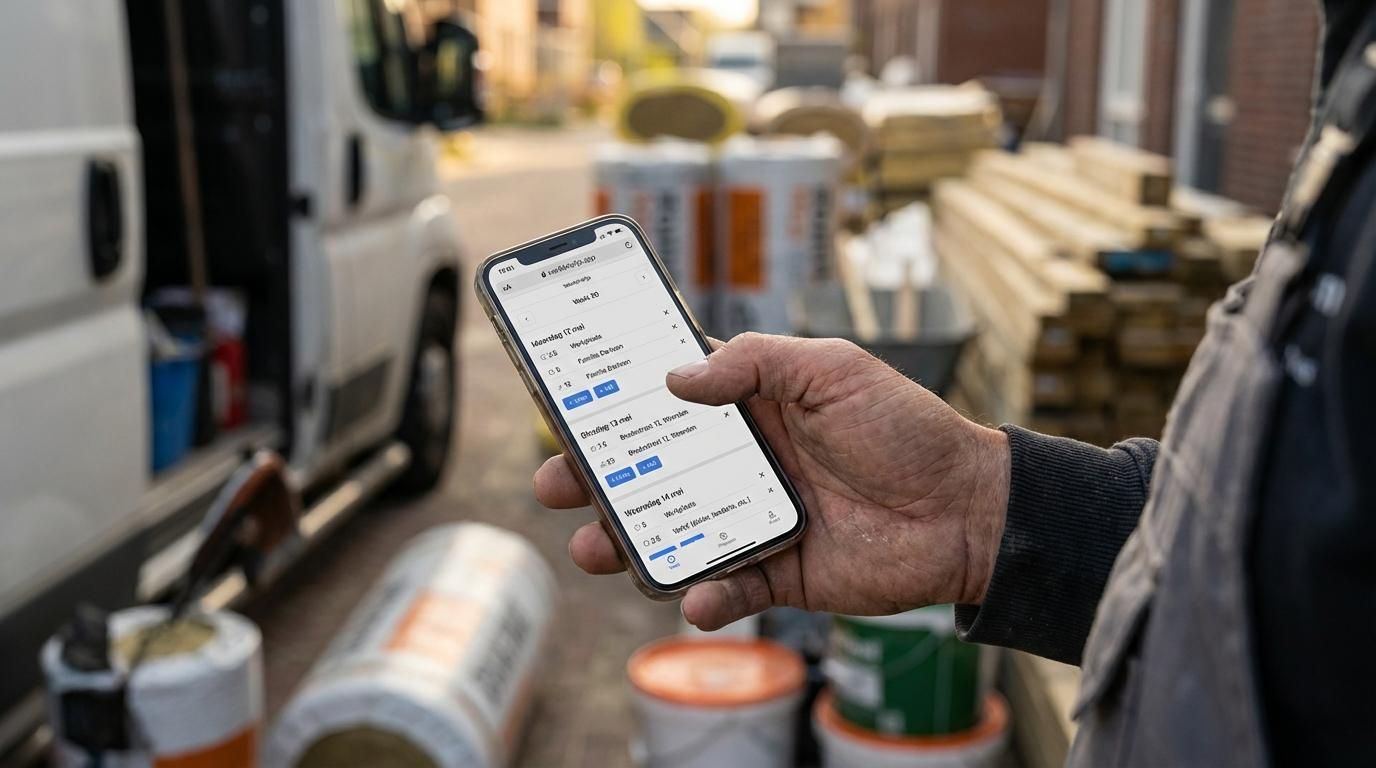
Werkbriefje.app is an example of such an approach: hours, material, rite and project notes come together in one app and dashboard. For small construction and installation companies That is convenient because it does not require a heavy ERP project or complicated setup. The main goal is: less paper, fewer loose lists, more overview per task.
If you want to do this effectively, it helps to record a mini-set of data every day. Think of:
- Consumed material: number, type, and where applied
- Residual material on site: what is left, and where exactly
- Return/drain: what went back to the supplier or to the bus
- Additional work: extras with photo and brief explanation
That seems like a lot, but if it is a fixed ritual, it takes little time.
Smart inventory and returns management: turn leftover materials into “money”
Residual material is only waste when you dispose of it. In practice, residual material disappears mainly because no one knows what it is, where it is located, or whether you are still allowed to use it on another job.
A few simple agreements already make a difference:
- Work with one “return crate” per bus or crew and empty it at a fixed time.
- Record returns with date and reason (incorrectly ordered, surplus, damaged).
- Agree with suppliers on what you can return and within what timeframe.
- Put usable leftover stock on a short list, so you include it in the next job.
One short sentence that is often true: unlabeled residual material becomes waste automatically.
Security and damage prevention without overkill
Theft and damage are not only a problem on large construction sites. The risk is particularly high at small, constantly changing locations, because storage is often temporary and routine is lacking.
You don't have to invest heavily right away. Start with the basics: lockable storage, no visible small parts in the van, and a regular “end of day” check. And if material is sensitive to moisture or sun, treat it accordingly. Plasterboard and insulation that get wet cost you not only material but also repair work and delays.
Quick win: signs that your material is leaking
Sometimes you only realize late that things are going wrong. These signals often point to structural material loss or misregistration, and can usually be remedied with a few process agreements.
- Many “rush trips” to the wholesaler: your planning or count is incorrect, or material gets lost
- Recurring undestined surplus stock: you order too much, or you do not label and register
- Discussions regarding quantities during invoicing: material has been used, but not booked
- Unexplained differences between calculation and consumption: cutting loss, damage, or incorrect execution creeps in
If you recognize this, it is often smarter to track very strictly for one week than to change everything immediately. One good week already gives you a usable baseline measurement.
This is how you make it feasible for small teams
It only works if it doesn't remain “extra work”. Therefore, keep it small and repeatable:
- Choose one moment per day to log (for example, before leaving the job).
- Let one person per team be ultimately responsible for the work order.
- Agree that material without registration does not exist. Firm, but clear.
- Use photos for additional work and deviations; that saves text and discussion.
Many companies realize that it is not about perfection, but about rhythm. If you save 5 minutes every day on searching and misunderstandings, you suddenly have breathing room at the end of the month, lower write-offs, and neater invoice preparation.
If you want to try one thing tomorrow: at the start of the job, write down on paper or in your app which materials you expect to use, and at the end, check off what was actually used and what is left over. That simple difference between “expected” and “actual” is often exactly where material loss becomes visible.

Owner Werkbriefje.app