Retention obligation for work orders and time records: how long do you have to keep what (and why)?
Work orders sometimes seem like “merely” internal notes: a few lines about hours, some materials, and a customer signature . Until a question arises from the Tax Authorities, a discussion about overtime, or an inspection of working hours. Then work orders and time records turn out to be exactly the documents you use to substantiate what happened, when, by whom, and at what cost.
He who keeps it usually does not need to use it. He who does not keep it always needs it.
In this article
What are work orders and what falls under time registration?
A work order is not a formal legal term, but in practice, it is the document used to record a job or (part of a) project. Think of work performed, materials used, trips driven, and hours worked. This data quickly touches upon multiple “administrations” simultaneously: your project administration , your invoicing, and your tax documentation.
Time recording is broader than a list of “8 hours worked”. For employers, it also concerns start and end times, breaks, overtime, and rest periods, as this relates to the Working Hours Act (ATW) and the Working Hours Decree.
What you often group under these documents and data in the construction and installation sector:
- Work orders per job/project
- Timesheets (day, week, month)
- Material rules and recalculation
- Trip and mileage records
- Photos and notes on additional work
- Approvals (client, contractor, project manager)
The basic rule: 7-year tax retention obligation
Entrepreneurs are subject to a fiscal record-keeping and retention obligation. In essence, it comes down to this: you must maintain your records in such a way that the Tax and Customs Administration can verify your rights and obligations, and you must retain those records.
The standard term is 7 years . This also includes work orders if they are part of your substantiation for revenue, costs, VAT, and profit. So not only your invoices, but also the “source” underneath them. Work orders are often exactly that source.
There is a well-known exception: data relating to immovable property (real estate) may be subject to a 10-year period for VAT purposes. If you are working on renovations, installations in buildings, or completion projects, this is something to clarify with your accountant.
Staff time tracking: Keep available for 52 weeks
If you have employees, an employment law obligation is added on top of the tax retention obligation. The Working Hours Act (ATW) requires proper registration of working and rest times. The Working Hours Decree links this to a retention period of at least 52 weeks.
In practice, this means that you must be able to demonstrate the time records used to prove whether rest periods and maximum working hours are correct for at least one year. This is separate from the 7-year fiscal period. Many companies therefore choose to simply align work orders and timesheets to 7 years, so that you do not work with different archives and data cleanups.
A self-employed professional without employees is not subject to the ATW registration requirement for employees, but remains an entrepreneur with a tax retention obligation. Even then, documentation of hours and work orders is often important, if only to substantiate your invoices, quotations, and final calculations.
Payroll records: 5 years (and why you often keep them longer anyway)
Employers also have to deal with regulations regarding payroll administration. From that perspective, a minimum retention period of 5 years is often mentioned. However, payroll data and everything related to wages and invoicing are mixed together in many administrations. Timesheets are a good example of this.
That is why you often see this approach in practice: retain wage and hours documentation for as long as your tax records (7 years), so that when questions arise, you do not have to figure out which set was “actually leading.”
Overview of retention periods in one table
The table below helps you quickly determine the minimum period you must adhere to. Please note: these are general rules. A collective labour agreement, contractual agreement, or insurer may impose additional requirements.
| Document / registration | How? | Minimum retention period | Why this is being asked |
|---|---|---|---|
| Work orders (hours, activities, materials) | Entrepreneurs and employers | 7 years | Substantiation of turnover, costs and VAT |
| Tax administration (purchases, sales, banking, invoices) | Entrepreneurs and employers | 7 years | Auditability by the Tax and Customs Administration |
| Data regarding real estate (VAT) | Entrepreneurs and employers | 10 years | VAT revision rules for real estate |
| Time registration for working and rest times (ATW) | Employers | 52 weeks | Monitoring working hours/rest periods |
| Payroll administration (key documents) | Employers | 5 years | Verification of payroll taxes and contributions |
Paper, PDF, or app: what can you save and how?
You may keep your records on paper or digitally. The requirement lies primarily in completeness, readability, and accessibility during the retention period.
An important point that often goes wrong: if your records are originally digital, “just print and throw the file away” is usually not a good idea. The Tax and Customs Administration wants your data to remain verifiable in the format in which you maintain it. Converting to another medium is permitted, provided the conversion is correct and you can make it readable again later.
In practical terms, this means that you must make agreements regarding your archive, regardless of whether you work with paper work orders or in an app:
- Storage structure: per year and per project, or per client and per year
- Searchability: by date, project number, employee
- Access managementNot everyone needs to be able to adjust everything.
- Backups: not only “in the cloud”, also a recovery plan
What goes wrong if you lose work orders?
Without work orders and documentation of hours, you are in a weaker position regarding three types of questions: fiscal, operational, and legal.
From a tax perspective, the Tax and Customs Administration can impose corrections or estimate your figures if your records are insufficient. This causes hassle and takes time, often precisely at a moment when you want to focus on your projects. The burden of proof also plays a role: if you deduct or pass on an expense, you must be able to demonstrate it.
Operationally, you notice it during invoicing. Additional work without a photo, note, or agreement on the invoice quickly becomes a dispute. And if material lines are missing, your margin erodes unnoticed.
Legally, you see this reflected in wage or hours disputes. If an employee claims to have consistently worked too much, and you cannot provide proper documentation, you are quickly at a disadvantage.
A workable retention policy for small construction companies and self-employed professionals
Preservation doesn't have to be complicated, if you keep it simple and the team follows the same routine. The trick is not to wait to think about archiving until the job has been finished for months.
An approach that often works well:
- One moment a week: check receipts and (digitally) “close”
- One owner: someone responsible for completeness, not for entering everything
- One term: use 7 years as the standard, with a flag for real estate (10 years)
Also make concrete what “complete” means. Not just hours, but context as well.
Here is a short checklist you can use when setting up your process:
- Complete definition: hours + materials + trips + explanation of deviations
- Agreements regarding corrections: who is allowed to make changes, and how do you document that
- Proof of additional work: photo, note, moment of agreement
- Export option: pdf or spreadsheet per period/project
- Continuity: backup and access arranged in case of phone or personnel change
Working digitally: less searching, more certainty
Paper work orders are not “banned,” but they are vulnerable. They get lost, get wet, or disappear in a van. Digital registration doesn't magically solve that, but it does make it easier to consistently keep, retrieve, and consult when questions arise.
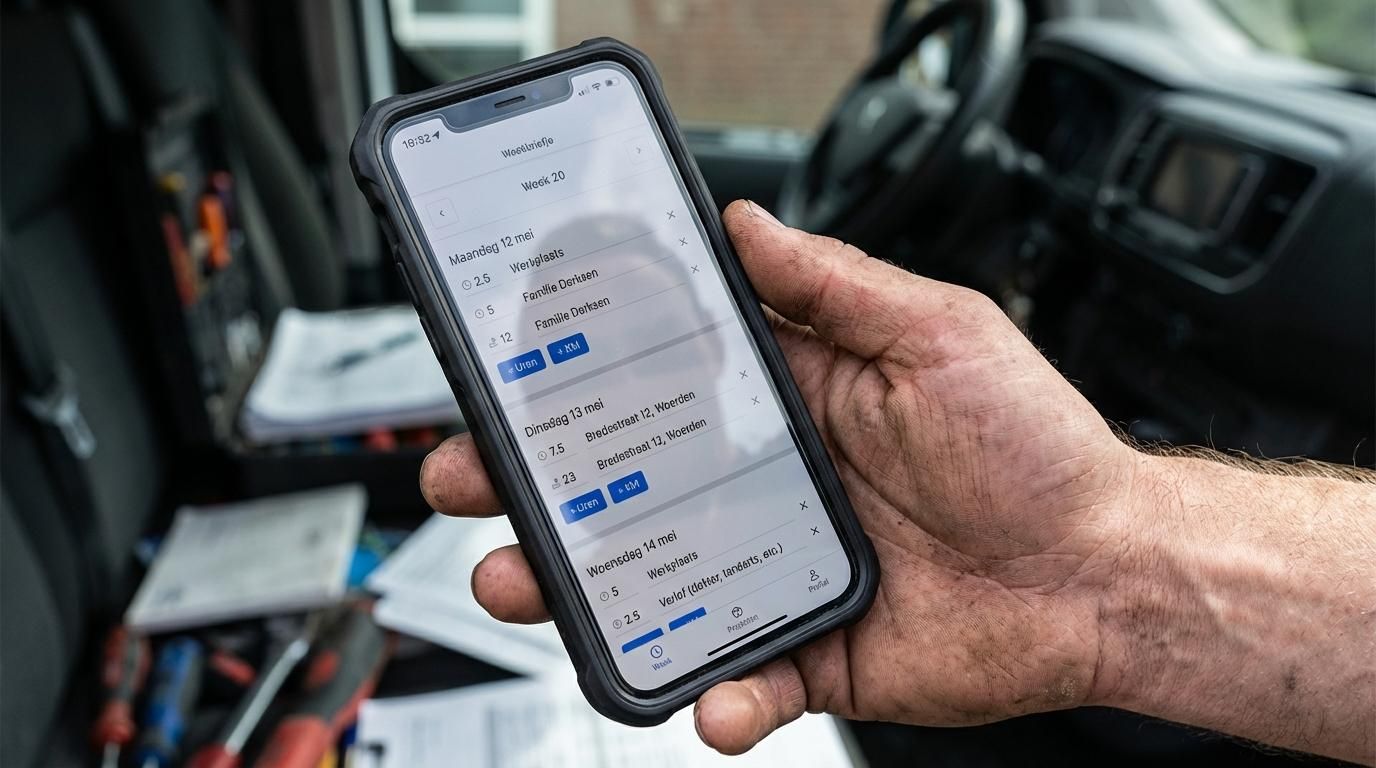
What many construction and installation companies appreciate about an app with a web dashboard is that you record work orders, hours, materials, and trips in a single system. This helps with two moments that are often painful: the weekly closing and invoice preparation.
With a solution like Werkbriefje.app In that case, it is not about additional functions, but about basic features that work in accordance with retention requirements: central storage, working with projects, fixed fields for hours and materials, photos and notes regarding additional work, and overviews that you can use for accounting or auditing. It is also relevant that you work with personal logins, so that not just anyone can access all the data.
A practical rule of thumb for digital archiving: ensure that you can provide a complete file per project within a reasonable time, including who entered and approved what and when. That is exactly what you need during an audit or dispute.
Retention period is simple, your process is the real work
Legislation sets deadlines. Practice requires discipline. If you complete your work orders every week, close projects neatly, and keep your archives consistent, the retention obligation becomes primarily a matter of keeping things calm.
And you see this reflected where it counts: fewer corrections afterwards, faster invoicing, and if you have questions, you can simply access the file.

Owner Werkbriefje.app