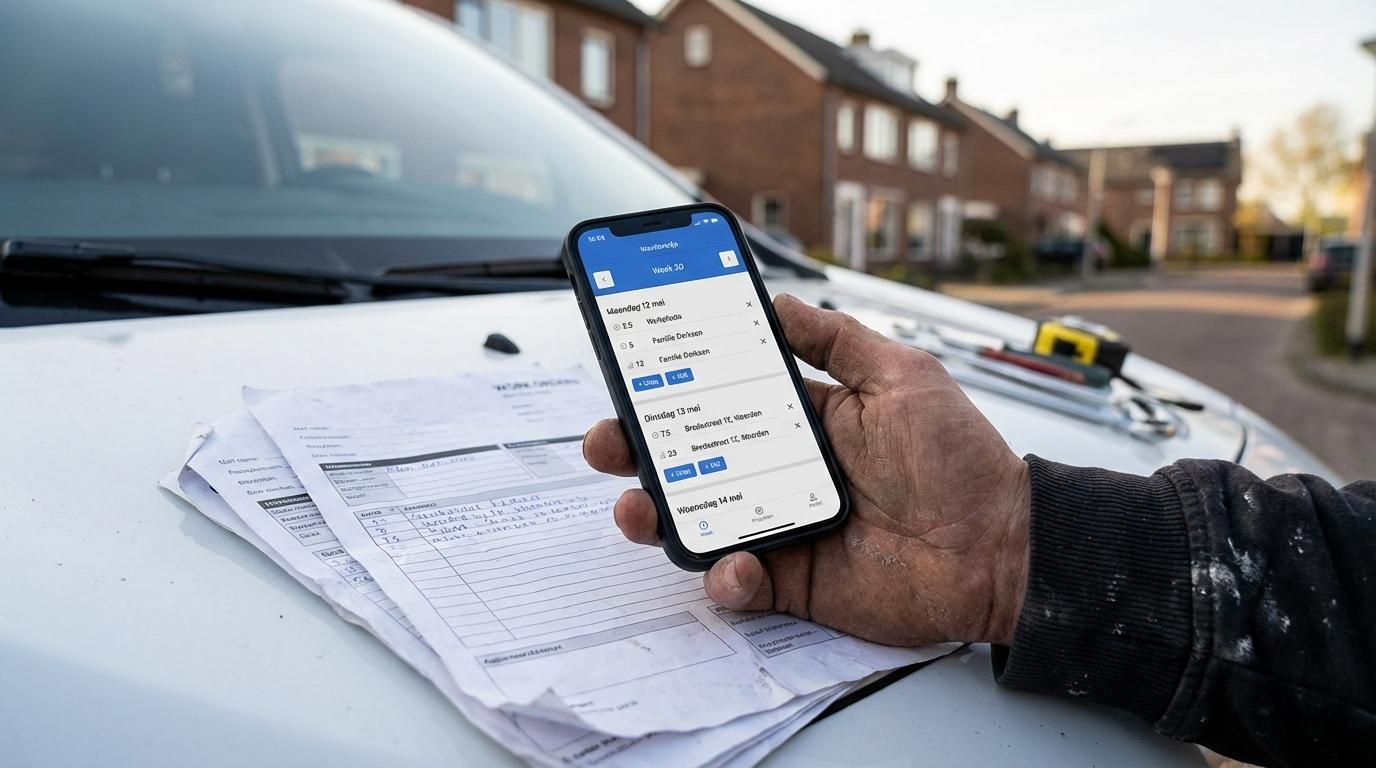
Work order, packing slip, or order form: differences and when to use which one
On the construction site, on the van, or at the office: “Which order form do you mean exactly?” is a question that comes up more often than many entrepreneurs would like. Work order, packing slip, order form… the words sound similar, but they correspond to different moments in your process and serve a different purpose.
Those who mix up the terms are more likely to get into discussions about what has been ordered, what has been delivered, and what work has been done. With a few clear agreements, you prevent this, and invoicing also goes much smoother.
In this article
Three vouchers, three roles (and usually three moments too)
The simplest way to remember the difference is: an order form switches something “on”, a packing slip confirms what is “being included”, and a work order records what has been “done”.
In practice, these flows sometimes overlap, especially in construction and installation companies where you supply both labor and materials. In such cases, a single project can simultaneously have an order form (contract), a packing slip (delivery to location), and multiple work orders (hours and activities per day).
A brief misconception to clear up immediately: none of these receipts is an invoice. They are supportive, but precisely for that reason, they are extremely important as substantiation.
Order form: recording what has been ordered
An order form (also: purchase order or order confirmation) is the document in which you record the agreement before anything happens. Think of it this way: the customer agrees to a quotation , and you convert that into an order with clear terms.
That one document prevents a lot of noise.
An order form often states:
- customer and project data
- order date and order number
- description of products and/or services
- quantities and often also prices or conditions
- desired delivery date or schedule
It is important that an order form provides direction to the rest of the chain. If someone later asks, “What exactly was agreed?”, this is your starting point.
An order form is often used by sales and administration, and subsequently by the warehouse or execution as a reference: this is what needs to be done.
Packing slip: check what has been delivered
A packing slip (also: delivery note) accompanies physical goods. It is the checklist for what is included in a shipment, or what you deliver on location. Warehouse employees use the packing slip to pick and pack; the recipient uses it to check if everything is correct.
Usually, there are no prices on a packing slip. This is intentional: it is a logistical document, not a financial document.
A packing slip typically contains:
- sender and recipient (with delivery address)
- packing slip number and date
- reference to order number or project
- items with item number/description and quantities
- possibly: backorders or partial deliveries
- Space for a signature upon receipt
For construction companies, the packing slip primarily comes into play regarding material flows: delivery from your own warehouse, a hub, or when taking items to a job and wanting to document this for the client or main contractor.
Work order: record what has been performed (hours, materials, overtime)
The work order (or work sheet) is the work document for the execution. On it, you record what was done on location, when, by whom, how much time was spent on it, and what materials were actually used.
In construction and installation technology, this is often the basis for your cost calculation and your invoice. Especially for time-and-materials work, breakdowns, maintenance, and additional work , the work order is your anchor: without clear record-keeping, disputes arise regarding hours, trips, and “small” materials that add up nonetheless.
A signed work order is also practical as proof that a job (or a phase) has been completed, or that additional work has been discussed and carried out.
Overview in one table
The table below helps to see the difference at a glance.
| Document | Main goal | Moment in process | Focus | Put prices on it? | Signature usually for… |
|---|---|---|---|---|---|
| Order form | Record assignment | Before execution/delivery | Agreement and scope | Often | Agreement on assignment (sometimes) |
| Packing slip | Check delivery | During/after shipment or delivery | Goods and quantities | Usually not | Receipt of goods |
| Work order | Register execution | During/after work | Hours, work, materials, trips | Can (but doesn't have to) | Approval of work performed |
Common confusions that cost money
Things rarely go wrong due to “one big mistake”. It is usually small oversights that accumulate: a work order without approval, a packing slip mistaken for an invoice, or an order form with vague descriptions.
A few recognizable situations:
- The customer signs a packing slip, but thinks that he has approved “the entire project”.
- The technician notes materials on the work order, while the warehouse and administration only look at the packing slip.
- An order form contains a price, but no clear exclusions, making it difficult to substantiate additional work afterwards.
If you want to organize one thing tightly: ensure that every document has one main task. Then you can also consistently manage it.
When do you use which voucher? Practical scenarios
In the construction and engineering sectors, you see roughly three types: purely service work, work with own materials, and delivery without installation.
For service work (maintenance, troubleshooting, installation), the work order is the primary document. While an order form may sometimes exist (for example, after approval of a quotation), the actual day-to-day reality is recorded on the work order.
For deliveries (or partial deliveries), the packing slip is the primary document regarding quantities. The work order then serves as a supplement for hours, trips, and any additional actions performed on location.
In larger projects, they run parallel: order form for the scope, packing slips per delivery, and work orders per day or per shift.
What should be included on a good work order as a minimum
Anyone who works with work orders quickly notices that “just filling it in quickly” often leads to gaps. And gaps turn into discussions.
Ensure your work order covers at least these items:
- Client and location: Who is the client, where was the work performed, and who was the contact person?
- Date and times: start/end, breaks, travel time, possible breakdown service.
- Activities: Short and concrete; rather “meter cabinet expanded with 3 circuits” than “electrical work done”.
- Material: quantities, description, and preferably item or brand/type if relevant.
- Additional work and deviations: What extra work was done, why, and what was agreed upon on site? Add photos if that helps.
- Agree: Name and signature (digital or on paper), plus comments if something was not finished or is not agreed.
That last line is often the most important. Not because a signature prevents all discussion, but because you show that it has been checked and coordinated.
Digital registration: less searching, faster invoicing
Paper receipts work, until they get wet, get lost, become illegible, or only arrive at the office after two weeks. Then the real work begins: retyping, making follow-up calls, estimating, and hoping it’s correct.
For small construction and installation companies, digital registration is particularly interesting if it remains simple. Werkbriefje.app is an example of that: it focuses on digitizing timesheets without setting up a heavy ERP system.
What you often see working in practice:
- Enter hours per project and per day into an app, distinguishing between normal hours, overtime and travel hours.
- Link material directly to the job, so that it doesn't end up "on a piece of paper somewhere".
- Mileage registration with automatic distance determination via Google Maps, so that rite give less discussion.
- Photos and add notes for additional work or deviations, the moment you see them.
At the office, everything comes together in a dashboard. There you can check, approve, and prepare projects for invoicing. For teams, that is often the difference between invoicing on Friday or only “when all the slips have come in”.
Werkbriefje.app is offered at an indicative price of €12,50 per user per month (excl. VAT), which makes it clear for smaller teams in terms of costs.
Numbering, archiving, and retrieving: make it easy for yourself
Receipts only have value if you find them. That sounds trivial, but it is exactly where things often go wrong: “Which receipt belonged to that job from March?” or “Which delivery was included with that partial invoice?”
A few practical agreements will immediately make things calmer:
- Use a single continuous numbering per type of slip (order slip, packing slip, work slip).
- Put at least the project number and customer name on every document.
- Record where the agreement is located: on the work order (execution) or on the packing slip (receipt).
- Keep track of who filled out the form and who approved it.
With digital work orders, it helps if photos, notes, and records are automatically attached to the correct project. This not only saves search time but also strengthens your substantiation should questions arise later regarding additional work or material consumption.
One simple process agreement that prevents a lot of hassle
Agree internally: “What we sell is on the order form, what we deliver is on the packing slip, and what we do is on the work order.”
As soon as everyone uses that phrase, it suddenly becomes difficult to pick the wrong receipt. And you notice that on the invoice, in communication with the customer, and in your own project overview.

Owner Werkbriefje.app