Communicating additional work to clients: sample texts and tips
Additional work is rarely the problem. The surprise is the problem. Customers are startled not only by extra costs, but especially by the feeling that they had no choice or that information came too late. For you as a tradesman or small construction company, the profit lies in a consistent approach: notify immediately, explain clearly, include the price and schedule, and only carry out work after approval.
In this article, we discuss how to document additional work , provide sample texts for requesting approval, plus practical tips for keeping the conversation professional and friendly, even when the client reacts critically.
In this article
What exactly is “additional work” (and why does it lead to discussion)?
Additional work is extra work that falls outside the original agreement. Examples include hidden defects (wood rot, pipework, misalignment), additional requests ("move that wall after all"), or work that proves necessary to achieve quality.
Discussion often arises from one of these causes:
- The customer thought it “was part of the deal”.
- You did say it, but didn't put it in writing.
- No clear amount or range has been mentioned.
- The schedule is changing, but no one knows what that means for delivery.
A brief telephone consultation feels quick and personal. However, in the event of disagreement, you have nothing to fall back on. That is why a combination works well: first explain verbally, then confirm in writing.
Channel selection: how do you request consent in a way that also provides proof?
You can discuss additional work by phone, on location, by email, via WhatsApp, or via a work order app . Every channel has its place.
| Channel | Speed | Show | Evidence/traceability | Best effort |
|---|---|---|---|---|
| In person | High | Personal | Low (unless fixed) | Initial explanation, show what you think |
| Phone number | High | Human | Low | Quick alignment, relieving tensions |
| WhatsApp/SMS | High | Informal | Intermediate | Short confirmation with photo and amount |
| Intermediate | Business | High | Clear agreement, attachment/quotation, terms and conditions | |
| Work order app (e.g. Werkbriefje.app) | High | Professional | High | Photos, notes, “approved” status, everything at project level |
For small construction and installation jobs, this is often the most pleasant route: discuss it directly on site, then send a brief confirmation (email or WhatsApp) with photos and a clear request for approval. This keeps things personal and properly documented.
The content that must always be included in your additional work notice
A customer can only truly say “yes” when it is clear what they are saying. Keep it simple and complete. A practical structure:
- What did you find or what is the additional wish
- why is it necessary or what does it yield
- costs and time (hours, material, total or bandwidth)
- effect on planning (shift or no shift)
- explicit request for consent, including how the customer can give consent
This short checklist prevents 80 percent of the noise. It also helps if you need to send a quick message on the bus.
- Description: what extra are you going to do, in plain language
- Reason: why necessary or desired
- Costs: hours, material, total (or a range)
- Schedule: delay or no delay, what is the new estimate
- Question of agreement: “Please provide your agreement via email/WhatsApp/app before we proceed”
Sample texts: request approval for additional work (copyable)
The texts below are written so that you can copy and adapt them. Always fill in the brackets and add a photo where possible. Photos often immediately calm the conversation, because you show what you mean.
1) Sample email text (business, complete)
Onderwerp: Akkoord meerwerk [Project/Adres] – [korte omschrijving]
Beste [Naam],
Tijdens de werkzaamheden op [adres] hebben we het volgende geconstateerd: [korte omschrijving van het probleem/wens].
Om [reden: schade te voorkomen/kwaliteit te borgen/uw wens uit te voeren] stellen we voor om het volgende extra uit te voeren: [concrete werkzaamheden].
Kostenindicatie meerwerk:
- Arbeid: [x] uur à €[tarief] = €[bedrag]
- Materiaal: €[bedrag]
Totaal (excl. btw): €[bedrag]
Planning: dit zorgt naar verwachting voor [geen vertraging / +1 dag / oplevering verschuift naar (datum)].
Wilt u per antwoord op deze e-mail akkoord geven op dit meerwerk? Na uw akkoord plannen we dit direct in.
Met vriendelijke groet,
[Naam]
[Bedrijfsnaam]
[Telefoonnummer]
2) Example WhatsApp text (short, yet complete)
Hoi [Naam], ik ben op [adres] en we kwamen [probleem] tegen.
Advies: [korte oplossing], zodat [reden/voordeel].
Meerwerk: €[bedrag] (± [x] uur + materiaal). Planning: [geen wijziging / +1 dag].
Wil je akkoord geven? Dan pak ik het meteen mee. Ik stuur ook even een foto.
Tip: Never include the amount and the request for agreement in just a separate “OK?” after it. Write it in one message so that the context can be read back later.
3) Sample text for an oral interview on location (with summary)
Say it in two steps: first the facts, then the choice.
Step 1 (factual):
“During the work I see [what you see] here. If we leave this as it is, there is a good chance that [effect].”
Step 2 (choice with impact):
“I can fix this right now. That is extra work: about [x] hours and €[materials], totaling around €[amount]. Then the schedule remains [the same / shifts to (date)]. Would you like me to include this?”
Then send a short confirmation via app or email with the same information. That is the moment you truly confirm the “agreement”.
4) Example text for additional work based on a client request (“while we’re at it…”)
Beste [Naam],
U gaf aan dat u ook graag [wens] wilt laten uitvoeren. Dit onderdeel zat niet in de oorspronkelijke offerte.
We kunnen dit meenemen als meerwerk: [omschrijving].
Kosten: €[bedrag] (excl. btw). Planning: [effect op planning].
Graag uw akkoord, dan nemen we het mee in de uitvoering.
Met vriendelijke groet,
[Naam]
5) Example text for unforeseen situation (hidden defect)
Beste [Naam],
Bij het openmaken van [onderdeel] is gebleken dat [verborgen gebrek]. Dit was vooraf niet zichtbaar.
Om het werk goed en veilig af te ronden is extra herstel nodig: [omschrijving].
Indicatie meerwerk: [x] uur arbeid + €[materiaal], totaal €[bedrag] (excl. btw).
Planning: [effect].
Kunt u akkoord geven op dit meerwerk? Zonder akkoord kunnen we dit onderdeel niet uitvoeren en kunnen we het werk op dit punt niet netjes opleveren.
Met vriendelijke groet,
[Naam]
That last sentence (“without agreement…”) is sometimes necessary. Keep it calm and factual. No pressure, but clarity.
What to say and what not to say: practical sentences that prevent resistance
Customers quickly see through the “it just has to be done” attitude. It is better to say what you see, what the risk is, and what the options are. It also helps to briefly check if everything has sunk in.
- Clear language: “I have found X, which causes Y. The solution is Z.”
- Choice language“We can include it now or schedule it separately for later.”
- Return control“You decide, I just want to prevent you from being faced with surprises afterwards.”
- To summarize: “Is it correct that you agree to €[amount] and delivery on [date]?”
A few things almost always work against you, even when you are right:
- Vague words: “just”, “a trifle”, “not too bad” (that reads like trivializing)
- Professional jargon“this is just a specification amendment” (fine internally, bad towards the client)
- Report afterwards: “We have already done it, because it had to be done” (that is often what the discussion is about)
How to smartly record agreement (without paperwork)
If you work with separate messages and emails, it can still get messy. Then you end up searching later for “that one photo” or “that agreement”.
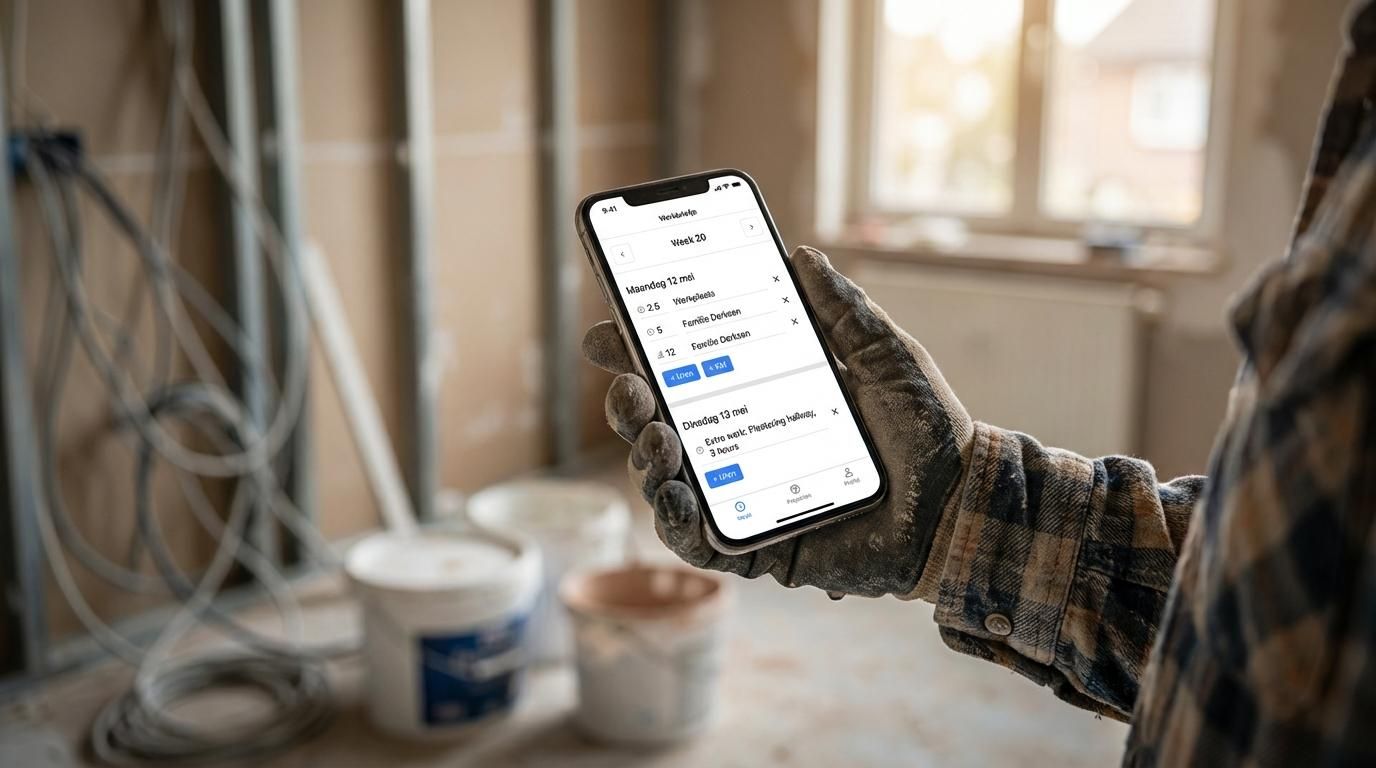
A work order app can structure this, because everything is grouped together per project: hours, materials, rite, notes and photos. In Werkbriefje.app You can register additional work with photos and an explanation, so that in the event of a dispute, you can quickly show what was found and when you reported it. It is also useful that you can track the status, for example proposed and agreed, so that the same information is visible at the office and on the job.
That makes a particular difference for small teams, where the operator sees the signal and someone else creates the invoice.
Additional work and money: how to make it concrete without cornering yourself
Many professionals hesitate: should I quote a fixed amount or an estimate? A fixed price provides peace of mind, but can be risky if it is truly unpredictable. An estimate is acceptable, as long as you write it down clearly.
Practical options:
- fixed amount for a clearly defined extra job
- amount with bandwidth (“between €250 and €350”), including what the bandwidth causes
- hourly rate with a maximum (“maximum 4 hours, contact us first after that”)
If you mention a range, add one sentence to make it honest: “If the internal impact turns out to be larger than visible, I will stop and call you before proceeding.” That feels safe for customers.
Short scenarios with microtext (handy on your phone)
Sometimes you don't have time for a long email. You can send these sentences quickly and elaborate on them later.
Scenario 1: customer is hesitant
I understand. Shall I break down the extra work into labor and materials, and send you a photo so you can assess it?
Scenario 2: customer wants to think first
Fine. I am pausing this part. Could you let me know today before [time] if I can include it? Then I will meet the schedule.
Scenario 3: Customer asks 'Couldn't you have seen this?'
This was located behind/under [part] and was only visible after we opened it. That is why I am reporting this immediately, before we incur costs.
A workable process for every small construction company
If you always handle additional work in the same way, it feels predictable to customers. And predictability feels reliable.
You don't have to make a big deal out of it. A fixed routine is enough: identify, explain, document, approve, execute. With an app where you store photos, notes, and additional work related to the project, this becomes even easier, because the administration doesn't start only when you are back at the office.
That is exactly the moment when additional work changes from “a hassle” to “simply well arranged”.

Owner Werkbriefje.app