Post-calculation vs. pre-calculation: how to keep construction projects profitable
A construction project can appear perfectly profitable on paper yet turn out to be disappointing in the end. Usually, this is not due to one major mistake, but to many small deviations that add up unnoticed: an extra hour here, a forgotten material item there, a trip that wasn't recorded anywhere. With cost estimation and cost calculation, you get a grip on those deviations. Not as administration for the sake of administration, but as management information.
In this article
Why margins often leak away in construction
Construction is practical, dynamic, and dependent on circumstances. This makes costs difficult to predict. Meanwhile, fixed costs continue to accrue, the schedule is tight, and the client expects clarity regarding price and delivery.
The margin often leaks away in areas that feel “too small” to address immediately: short waiting times, extra masking, return trips to the wholesaler, miscommunication regarding additional work, or slightly too optimistic man-hour estimates.
A project does not become loss-making due to a single incorrect hourly rate, but due to a lack of timely signals.
Preliminary calculation: you start with a workable truth
A preliminary calculation is your estimate in advance: the number of hours, the materials, the deployment of equipment, and the risks. The result is your budget and often your quotation.
Important detail: a good cost estimate is not “as low as possible,” but “as verifiable as possible.” If you cannot compare later, you cannot learn. This means breaking down your budget into logical items (hours, materials, subcontracting, transport, preparation) and preferably also by phase or room.
Those who consistently provide cost estimates notice that conversations with clients become calmer. Not because everything is fixed, but because you can explain where your price comes from, what assumptions you have made, and what happens in the event of changes.
Post-calculation: retrospective is only useful if you provide feedback.
Post-calculation is the comparison between budgeted and actual. That sounds like “too late,” but it is actually the driving force behind better projects. You see where your estimates were correct, where your standard times do not fit, and which activities consistently run over schedule.
Post-calculation only truly works if the input is correct. That is where things often go wrong: hours are entered retrospectively, material slips are scattered around, mileage is estimated, and overtime has been performed but not recorded.
The goal is not to settle accounts with anyone, but to make your next calculation and execution sharper.
The difference at a glance
The table below helps to keep the practical distinction clear, including how you apply it in daily practice.
| Part | Preliminary calculation (in advance) | Post-calculation (after the fact) | Practical profit |
|---|---|---|---|
| Moment | Quotation and preparation phase | Upon completion or in phases | You are comparing apples to apples |
| Basic | Assumptions, drawings, standards, prices | Hours, purchases, receipts, trips, overtime | You see what “really” happened |
| Focus | What do we think it costs? | How much did it cost? | You learn and adjust |
| output | Budget, schedule, quoted price | Differences overview, margin per item | Better quotes and fewer surprises |
A post-calculation without a proper pre-calculation is mostly guesswork. A pre-calculation without a post-calculation remains guesswork.
Interim monitoring: post-calculation begins during execution
Many small construction companies only perform post-calculation once the project is finished. By then, the damage has already been incurred, and it is primarily “hindsight.” A practical approach is to review deviations weekly or at milestones. This does not have to be complicated.
You mainly need three questions:
- Are the hours On schedule?
- Are all props Booked on the right project?
- Is additional work Recorded and discussed immediately?
After such a check, you can decide: adjust the plan, inform the client, deploy extra staff, or discuss internally how to work smarter.
A weekly reality check prevents you from discovering that the margin has disappeared only with the final invoice.
Which project data you need at a minimum
You don't need ERP for usable post-calculation, but you do need discipline in record-keeping. It concerns recurring basic data, preferably per project and per day.
- Hours: working hours, travel time, overtime, leave/sickness where relevant
- Materials: quantities, description, cost price or purchase price, linked to the project
- Kilometers/trips: round trip, extra trips, deliveries
- Additional work: brief explanation, approval status, photos or notes
- Subcontractors: appointments and invoices linked to the same project structure
With just these five categories, you can often better monitor 80 percent of your margin.
Common causes of abnormalities (and how to recognize them)
Deviations are not always “setbacks”. Sometimes an item turns out favorably and that masks a problem elsewhere. Therefore, look at each item individually, not just at the total.
Here are patterns that often recur in construction:
- Budgeted hours are correct, but still too little margin: indirect time (loading/unloading, consultation, tidying up) is not included in your standard
- Material is running behind schedule, while the hours are better than expected.: ordered incorrectly, significant cutting waste, purchased too late
- Many short trips: missing schedule, or material not prepared for the project
- Additional work without invoice: done, not registered, or discussion about scope
It helps to routinely include these signals in your weekly or phase check.
From paper to reliable post-calculation: why record-keeping often falters
Paper timesheets seem fast, until you have to collect, read, correct, and retype them. Then noise sets in: illegible lines, missing receipts, hours that are “approximately” right, materials without a project number.
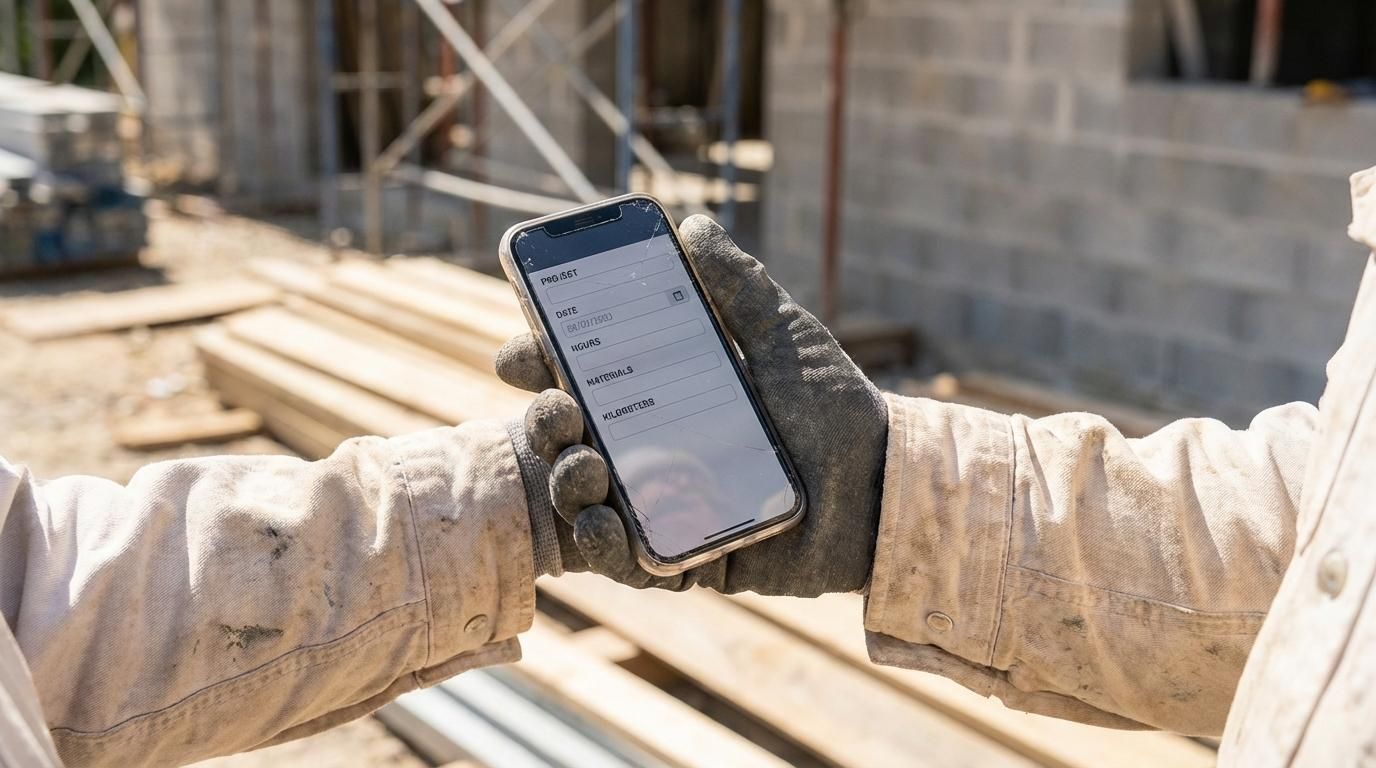
Digital registration doesn't solve everything, but it does make it easier to work consistently. Especially for small teams, the advantage is that information is generated directly where it happens: on the job.
Werkbriefje.app It is designed for that type of practice: recording hours, materials, trips, and project notes via an app, with a desktop environment for overview and control. The idea is simple: what you don't record, you can't calculate retrospectively, and usually, you can't invoice either.
A photo accompanying additional work is sometimes enough to prevent disputes later on.
Practical workflow that works well for small construction companies
The trick is to keep the process small. No thick reports, but fixed times and clear agreements.
A workable approach:
- Make your cost estimate item-oriented: hours and materials per part, not one total
- Register daily: hours, materials, and trips directly on the project
- Document additional work at the time.: note and photo, only then carry out or at least discuss
- Check weekly: deviations by mail, not just “feeling”
- Prepare projects for invoicing as soon as a phase is completed: fewer forgotten posts
- Incorporate lessons learned into your next proposal: adjust standards, storage, and planning
This is not a heavy administrative cycle. It is a rhythm that helps your team maintain calm during execution and clarity in the office.
What you can standardize without making your business “clunky”
Standardization sounds big, but it can start very small. Think of fixed cost categories, fixed project codes, and a fixed way to describe additional work.
A few examples that often yield quick returns:
- One fixed structure for project names and phases
- One list of material categories (not too long)
- One agreement regarding travel time and mileage
- One place where photos and notes belong to the job
If you combine this with a tool that makes registration easy, post-calculation becomes a normal part of your work instead of a task “for when things are quiet”.
Where you see results as early as tomorrow
Much of the profit lies in preventing forgotten work and invisible costs. Therefore, do not start with a perfect model, but by plugging the biggest leaks: hours entered too late, materials without a project, and additional work without documentation.
Choose one ongoing project and make it your pilot. Monitor it closely for two weeks, perform a one-week check, and see what deviations you already observe. These initial insights are often surprisingly concrete and immediately usable for your next cost estimate.

Owner Werkbriefje.app