What is post-calculation and why is it important?
Post-calculation sounds like something for large contractors with a controller and three dashboards. Yet, for small construction and installation companies, it is actually one of the fastest ways to gain more control over margins, planning, and invoicing.
In the construction industry, things rarely go exactly as budgeted. An extra trip, an hour's delay due to delivery problems, a few connections that turn out differently. If you only see the results weeks later (or not at all), you end up paying for those deviations yourself. Post-calculation reverses this: you record what actually happened and use that to steer more effectively.
In this article
Post-calculation in construction in one sentence
Post-calculation is comparing your initially estimated costs and hours with the actual expenditure, so that you see where your project makes a profit or a loss and why.
It is not an accounting exercise “for later,” but a practical tool during and immediately after work. The sooner you spot the discrepancies, the sooner you can make adjustments.
What exactly are you comparing?
With post-calculation, you compare the budget (calculation) with reality. This can be done at the project level, but also per component. In practice, the latter often yields useful insights, because you then see exactly where things are going wrong or, conversely, where they are going well.
Consider the differences between:
- budgeted hours and hours worked
- material according to quotation and material that was actually used
- planned number of trips and actual kilometers
- agreed additional work and additional work that has been done but not recorded
Post-calculation is therefore not only about “too many hours”, but just as much about forgotten materials, unbilled extras, or a schedule that is structurally too tight.
Why things often go wrong in practice
Many companies want to perform post-calculation, but get stuck on the same points. Not because it is complicated, but because the record-keeping system does not cooperate.
A few recognizable causes:
- You work with loose notes, WhatsApp, and memories in your head, causing data to be missing or illegible.
- Hours are entered “approximately” at the end of the week, causing small deviations to add up to large differences.
- Additional work is carried out, but is not recognized as such or documented with evidence (photo, note, agreement).
- Tracking mileage and travel time feels like extra paperwork, so it is not done consistently.
If you base post-calculation on incomplete information, you mainly get noise. Then it feels like extra work without return. The key is: simple recording at the moment it happens.
Here is a practical approach to post-calculation
Start small. You don't need a perfect cost calculation per screw right away. Choose a level that suits your company and the type of jobs you do. For one team, “total project” is enough, while for another, “per room” or “per phase” is smarter.
A workable approach usually consists of three steps: documenting, comparing, and adjusting. Adjustments can be made during the job, for example by discussing additional work before proceeding, or by adding extra material directly to the invoice.
The rhythm is also important. Post-calculation works best if you make it a standard procedure: take a quick look weekly, and evaluate briefly after a project is completed. Not to hold people accountable, but to improve assumptions.
What data do you need?
The less hassle, the better. For most small construction companies, these are the minimum building blocks for meaningful post-calculation:
- Hours per project (preferably per employee)
- Material per project
- Trips and kilometers
- Additional work with brief explanation
If you have this consistently, you can already answer many questions: where margin disappears, which job types are structurally budgeted too tightly, and which customer asks for “just this on top” remarkably often.
A practical way to maintain an overview is to group your records into fixed categories:
- hours
- material
- transportation
- subcontractors
- additional work
What you focus on: margin, planning, and agreements
Post-calculation is not just financial. It has a direct impact on your schedule and your team.
If you notice that a type of job almost always runs over time, you can:
- adjust your standard hours in your quotes
- choose a different work order
- do extra preparation (material complete in advance, clear drawings)
- a more realistic planning make, so you don't have to move around as much
And if you notice that extra work is often “forgotten,” it is rarely due to unwillingness. Usually, there is a lack of a fixed working method: documenting, requesting approval, and preparing for invoicing.
Additional work and invoicing: the moment when profit disappears
A lot of profit is lost during the transition from execution to invoicing. The job is finished, everyone moves on to the next, and the administration comes later. Then notes turn out to be vague, photos are missing, and it is no longer clear exactly what extra work was done.
What helps is to document extra work as if you need to be able to explain it later to someone who wasn't there. Think about the date, location, a brief description, materials, and possibly a photo. That makes the step to invoicing a small one.
Useful agreements to make internally:
- Definition of additional work: when is something truly extra and when does it fall within the agreement?
- Capturing on the day itself: don't wait until Friday afternoon.
- Add proof: photo and a short note, so that no discussion arises.
- Organize approvalVerbal communication is sometimes fine, but do put it in writing.
This is also where a digital work order process delivers significant benefits: less searching, less forgetting, and faster invoicing.
A simple example (with table)
The table below shows how post-calculation provides insight per component. The amounts are for illustrative purposes; it is about the perspective.
| Part | Budgeted | Really | Verschil | Remark |
|---|---|---|---|---|
| Work (hours) | 40 hour | 46 hour | +6 hours | Additional repair work due to subsurface |
| Material | € 650 | € 720 | +€70 | Extra kit and fastening consumables |
| Trips/kilometers | 120 km | 185 km | + 65 km | Extra back-and-forth for subsequent delivery |
| Additional work | € 0 | € 280 | +€280 | Extra wall installed, agreement recorded |
What you gather immediately from this is that the project ran over budget due to labor and trips, but part of this was compensated by invoiced overtime. Without properly documenting that overtime, this project would have been “simply less profitable,” whereas the reality is more nuanced.
How digital timesheets make post-calculation easier
Post-calculation stands or falls with record-keeping. Paper notes sometimes work fine, until your pace picks up or multiple people are working on multiple projects. Then delays occur and information is missing.
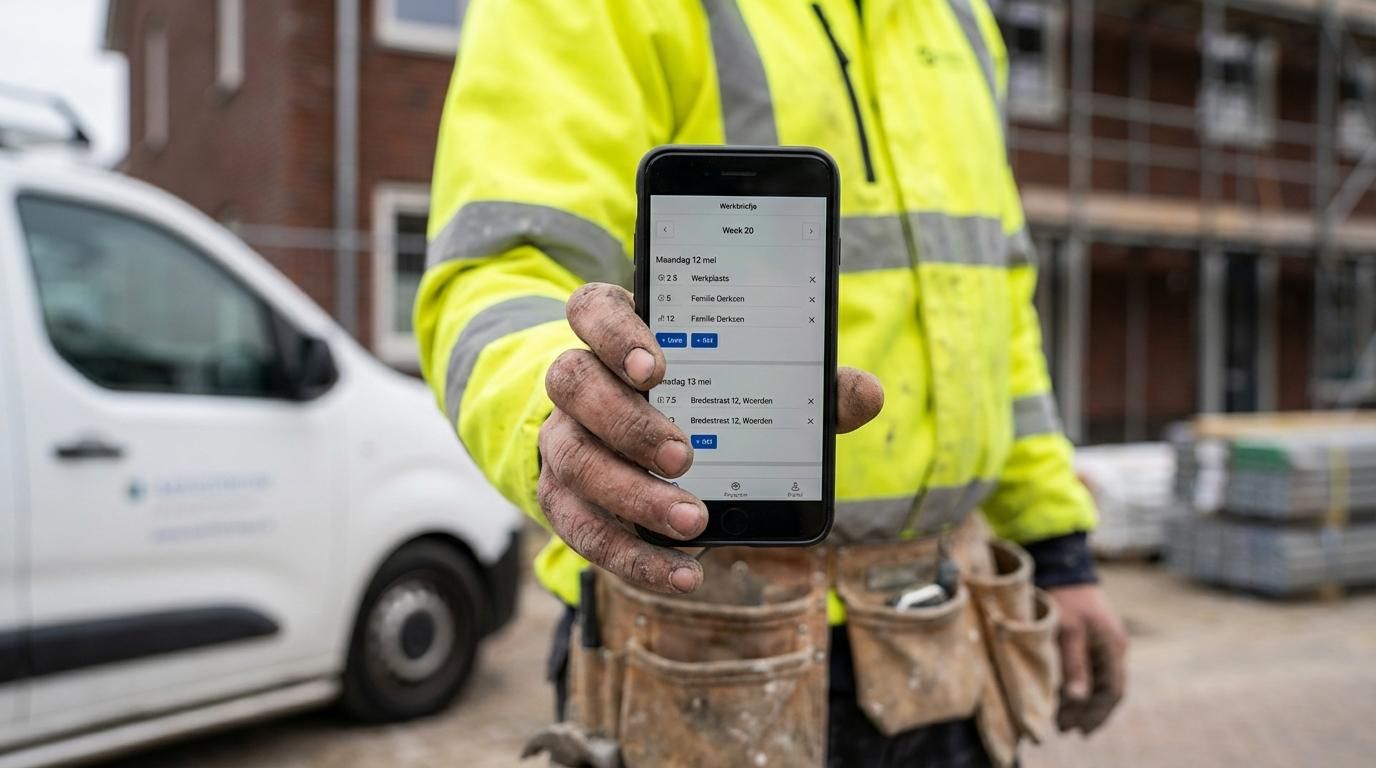
A digital work order or timesheet app helps primarily by recording everything in one place: hours, materials, trips, and project notes. If employees fill it out directly on the job, you have a more reliable picture in real time. This turns post-calculation from a monthly closing into daily management information.
Werkbriefje.app is an example of that: aimed at small construction and installation companies, with an app and desktop environment for hours, materials, mileage registration (with automatic calculation), photos and notes for additional work, and preparation for invoicing. The guiding principle is to keep it simple: the core records, but no unnecessary layers. The target price is €12,50 per user per month (excl. VAT), with options for customization and corporate identity.
When making your choice, pay particular attention to ease of use. If filling it out takes longer than a minute, discipline quickly wanes, and you will still end up with gaps in your post-calculation.
Post-calculation for freelancers and small teams: how to keep it manageable
You don't have to make it bigger than your company. For many freelancers and small teams, this works as a fixed routine:
- Record your hours and materials used per job every day.
- Document additional work immediately with one photo and one sentence of text.
- Review the top 3 deviations weekly: where was the most overrun or extra costs?
That is often enough to make your quotes sharper and your invoices more complete. And as you grow, you can expand the same method with additional project codes, phases, or cost types.
Frequently asked questions from practice
How quickly do you need to recalculate?
Preferably during the project and immediately after completion. If you wait a month, details are lost: why that extra trip, what material was it again, who worked where on which day.
Does post-calculation make sense for small, one-day jobs?
Yes, exactly. Small jobs often have thin margins and a lot of “edge time” (loading, driving, picking up). If you don’t see that, it looks like you’re busy but have little left over.
What if my budget is not that detailed upfront?
Then you start at the overall level. Roughly set out budgeted hours and materials, and refine by job type. Post-calculation helps you build your own standard times, even if you start with limited data.
Is cost accounting the same as bookkeeping?
No. Bookkeeping records financially for tax and annual accounts. Post-calculation is operational: it shows why a job turns out well or poorly, so that you can adjust your working method, planning, and pricing.
What does it usually yield first?
In practice: less forgotten extra work, faster invoicing, and a more realistic estimate of hours and travel time. These are often the first places where profit leaks away without anyone doing it intentionally.
Something you can start with tomorrow
Choose one ongoing project and agree with yourself or your team that from now on you will strictly track three things: hours, materials, and overtime. If that works for a week, add trips and mileage. This gradual build-up increases the likelihood that it will stick and that post-calculation becomes a habit rather than a one-off action.

Owner Werkbriefje.app