Why a construction cost estimate is indispensable
A job often appears profitable on paper, but in practice, you encounter surprises due to minor errors: an extra hour of work, a forgotten roll of foil, a few extra trips to the wholesaler. A cost estimate gives you immediate insight into these potential deviations. It is not a complicated report, but a practical calculation that puts your planning, pricing, and execution in order.
In this article
What do we mean by cost estimation in construction?
A cost estimate is a pre-calculated estimate of the costs, labor hours, and revenues for a project. You use this calculation to:
- to set a quotation price,
- to align your planning (including the deployment of people and equipment, and the lead time),
- and to monitor the budget during execution.
The document is short but powerful, tailored to your type of work. For a painter, it revolves around square meters, number of coats, scaffolding rental, and drying times. For an electrician, it counts regarding cable meters, number of circuits, installation time, call-out charges, and inspection dates. The estimate is based on your experience, available data, and clear agreements. It is therefore crucial that you clearly record the assumptions made.
Why you almost always pay without a preliminary calculation
If you work without a thorough cost estimate, you rely on intuition. While this may sometimes appear customer-friendly, you run significant risks. The cumulative effects of minor errors often result in you ultimately having to bear the extra costs yourself. An accurate cost estimate clarifies the necessary choices before you say “yes” to an appointment. Consider whether the job fits into your schedule, whether there is room for additional work, whether it involves a tight budget, and whether you can secure materials at stable prices.
After multiple projects, a thorough calculation also yields additional benefits. You can clearly explain to the client why certain options cost more, what the impact of an accelerated schedule is, and what uncertainties exist, for example regarding the subsurface or accessibility. Over time, you build up standard key performance indicators that make your calculations faster and more accurate.
The ingredients of a useful cost estimate
The reliability of a cost estimate depends on the data you enter. You do not need to know everything exactly, but you must proceed systematically. Ensure that you have the following input at hand:
- Quantities (m², meters, pieces)
- Production rates (hours per unit)
- Prices of materials and any discounts
- Costs for equipment and subcontractors
- Timeline and phasing of the project
- Risks and uncertainties
It makes sense to use the same cost categories for every quotation. This allows you to compare projects accurately and discover where things are going wrong more quickly.
Here is an overview of cost items that are often overlooked:
| Cost item | What often goes wrong? | Useful source |
|---|---|---|
| Working hours | Travel time, waiting time, consultation, tidying up | Time registration per activity |
| Material | Cutting waste, extra fasteners | Material list per room/component |
| Material | Rent per half-day, transport, downtime | Planning + rental agreements |
| Subcontractors | Coordination, additional work, waiting time | Clear scope agreement |
| Trips/kilometers | Extra pick-up/drop-off, parking and toll fees | Mileage registration and trip log |
| risk surcharge | Uncertain ground, weather conditions, delivery times | Risk list with concrete assumptions |
| General costs | Small tools, PPE, administration | Fixed percentage or project surcharge |
By completing this table with every quote, you avoid unnecessary costs that will later come at the expense of your profit.
Fixed price, cost-plus, or hybrid: you calculate differently than you think.
The type of contract you use determines how accurate your cost estimate needs to be.
In time-and-materials work, it is important to set clear expectations for the client and maintain control over hours spent and materials used. Here, your profit does not come from gambling, but from transparent record-keeping and accurate monitoring of the work.
With a fixed price contract, your margin lies in the difference between the actual costs and the agreed price. The cost estimate then serves as your line of defense; you pay for forgotten parts or cost items yourself. In practice, a hybrid model is often used: a fixed price for the basic work, or, under a cost-plus model, provisions for unforeseen circumstances or provisional sums for parts to be determined later. It helps to break down your estimate into components that you can track separately.
Some agreements that help with this:
- Scope: What falls within the scope of the assignment and what does not?
- Provisional items: Which amounts are reserved and under what conditions?
- Additional workHow do you record extra work and when do you coordinate this?
Accurately documenting additional work prevents you from negotiating later based on reminders and ensures that all extra costs are compensated.
A practical example: from estimate to preliminary calculation
Take a small renovation involving carpentry and finishing. You make an initial estimate of 60 labor hours, €1.800 for materials, and €250 for equipment rental. You calculate at €55 per hour and apply a 10% markup. This sounds comprehensive, but detail items are often overlooked.
You might forget travel time; suppose two people travel an extra half hour every day for four days, which amounts to four extra hours. Time for disposal and cleanup, extra trips for material deliveries, and loss due to cutting waste or extra fastenings can also easily be overlooked. In this example, that can add up to about 10 to 15 extra hours that you still have to account for.
A practical approach is to allocate the hours by activity, such as demolition, setting up, assembling, finishing, and delivery. Add a realistic extra time per day for loading, unloading, parking, meetings, and cleaning. This approach does not make your calculation more extensive, but it does ensure reliability. Moreover, during execution, you keep track daily of whether you are on schedule.
Pitfalls that silently eat away at your profits
Most problems do not arise from one major mistake, but from repeatedly making small oversights. A cost estimate helps prevent these errors. Common pitfalls are:
- Overly optimistic estimate of working hours
- use outdated material prices
- Forgetting short trips and extra pick-ups/drop-offs
- Do not reserve provision for failure costs and rework
- Do not record verbally agreed additional work
- No comparison between the original calculation and the actual costs
If you change one habit, perform a simple post-calculation after every job. This helps you adjust future quotes and prevents structural error margins.
Pre-calculation only really works with good work registration.
A preliminary calculation is a plan; the execution determines your final profit. That is why it is smart if your recording during the work seamlessly aligns with your original calculation. With a digital work order or a work order app, you can easily record what happens without spending hours on administration later. If data is added days later, you run the risk that discrepancies will no longer be detected in time.
For each assignment, you want to register at least the following:
- Hours: Including time for travel, overtime, and any interruptions
- Material: Per job or per room, with exact quantities
- ride: Mileage and travel time, preferably with automatic calculation
- Additional work: Photos and notes, linked to the original assignment
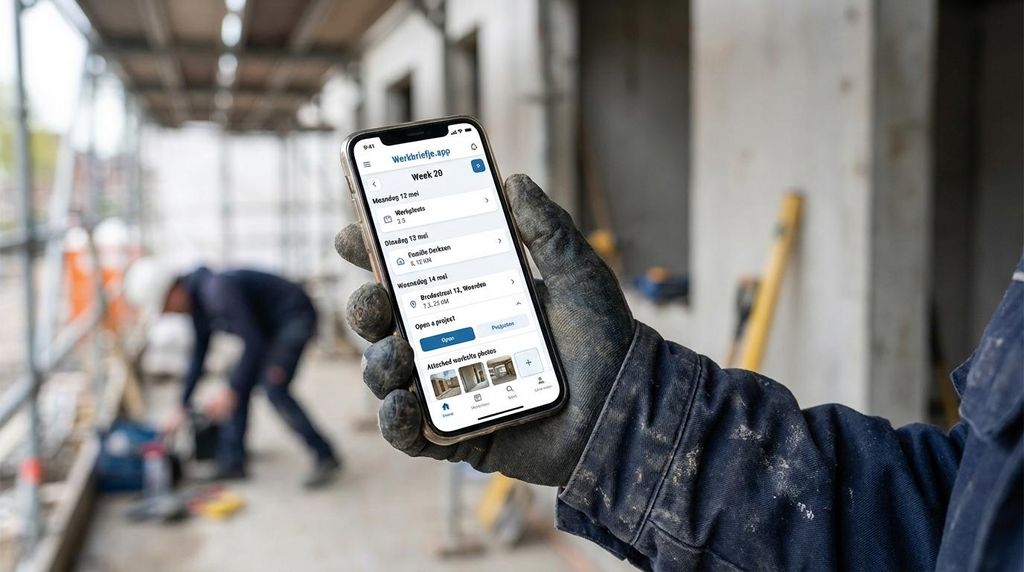
A specific app, such as Werkbriefje.app, replaces traditional paper worksheets with a digital solution suitable for small construction and installation companies. The system links your initial calculation to the execution, allowing you to quickly spot discrepancies and making invoicing more efficient.
A workable approach for small construction companies and freelancers
You don't need to become an expert calculator, but simply apply a fixed working method repeatedly. This ensures that you build up valuable data. A practical working method looks like this:
- Create a template with fixed categories (such as hours, materials, equipment, trips, storage, and risk).
- Use key figures that match your activities (for example, hours per m² or per group).
- Note the assumptions in the quotation, such as the condition of the subsurface and accessibility.
- Record consistently on the same categories during execution.
- Afterwards, compare the calculation with the actual execution and adjust your key figures based on the experience gained.
For a small team, daily recording (step 4) in particular makes the difference between a rough estimate and an accurate overview. A handy checklist for the workplace might look like this:
- Daily start: Discuss the schedule for the day and check if any materials are missing.
- Snacks: Document immediately if deviations or additional requests occur, with photos and notes.
- End of day: Register your hours in no time, use of materials and rides.
That discipline ensures that your cost estimate remains a living document that is continuously adjusted during execution.
Tools: Excel, calculation software, and work order apps
Many companies start with Excel. That works well, provided the sheet is logical and updated regularly. The problem often lies not in the program, but in linking the execution to the original calculation. Calculation software is useful for larger or repetitive projects, especially if you work with standardized articles and norms. However, proper setup and discipline are essential in this regard.
Work order apps are ideal for daily record-keeping and speed up the invoicing process. By documenting your hours, material usage, trips, and overtime in them, you have immediate access to all the data for accurate cost accounting. For example, Werkbriefje.app combines all registrations in one system with features such as automatic mileage registration via Google Maps, photos and notes for additional work, an overview per project, and an annual schedule using drag-and-drop. The price (approximately €12,50 per user per month excluding VAT) makes it feasible for small teams to get started without major investments.
Often, the smartest combination is a simple cost estimate (for example in Excel or a fixed template) with tight execution tracking via a work order app. This keeps everything organized and professional.
What you can already improve today in your next cost estimate
Start small and make it measurable: choose one type of job you perform frequently and set up a standard structure for it. Take the data from the last three projects and note for each project where things went wrong: in the records of hours, materials, trips, coordination, or repair work. Then, add one new rule to your calculation that you had not included before, for example, a fixed “edge time per day” or a percentage for expected cutting loss. If you apply that rule consistently and check it against your records, your calculation will become more accurate.
If administrative tasks take up too much time, keep it simple: record what happens immediately, with as few steps as possible. This way, cost estimation and execution balance each other efficiently.

Owner Werkbriefje.app